
Cut Your Finger? Here’s the 3-Step Response
Yesterday TOM lost a fight with a tin can. Today, the practical follow-up: the three calm steps for a minor cut — and the clear signs that it’s time to stop improvising and get help.
6/8/20263 min read
Of all the disasters in this series, this is the one you’re most likely to actually face. Mystery garage bottles and chest freezers are mercifully rare. A nicked finger while chopping veg, or a kid catching a knuckle on something sharp? That’s a Tuesday. So here’s the whole response in three steps you can keep in your head.
The good news is it’s genuinely simple, and the steps are the same whether the culprit is a kitchen knife, a tin lid, or — in TOM’s case — a screwdriver he was using as a can opener for reasons known only to him.
Apply pressure
Press firmly on the cut with a clean cloth, gauze, or tissue to stop the bleeding. Hold it — don’t keep peeking.
Clean the wound
Once bleeding slows, rinse gently under clean running water to flush out any dirt or debris.
Cover it up
Pat dry and cover with a clean plaster or dressing to keep it protected while it heals.
That’s the core of it. One small ordering note worth knowing: for a minor cut that’s barely bleeding, it’s fine to rinse first, then cover. But the moment there’s real bleeding, pressure comes first — stopping the blood flow matters more than getting it spotless, and you can always rinse once it’s under control. When in doubt: press, then clean, then cover.
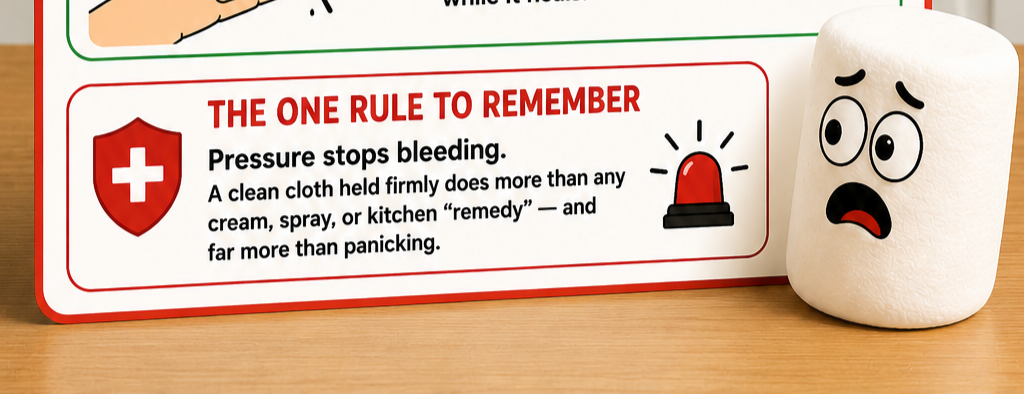
The one rule to remember
Pressure stops bleeding. A clean cloth held firmly does more than any cream, spray, or kitchen “remedy” — and far more than panicking.
Meanwhile, in TOM’s kitchen
TOM’s instinct was to reach for the salt and the foil. Reader, do not reach for the salt and the foil. Reach for a clean cloth and press.
The things people get wrong
Most cut-related mistakes come from a good instinct pointed in the wrong direction. We want to do something dramatic, when the cut just wants firm, boring pressure. So a quick “don’t” list: don’t pour salt, butter, toothpaste, or any other random thing into a wound — all you add is pain and a fresh batch of germs. Don’t use foil or kitchen roll as a bandage. And don’t lift the cloth every few seconds to check — you peel away the clot that’s forming and the bleeding restarts.
The other useful thing to know is what your body is busy doing under that plaster. Platelets form a clot that dries into a scab — a little shield over the repair site. White blood cells turn up to fight germs and clean house, so a bit of redness early on is normal. Then collagen rebuilds the skin underneath. The scab has a job; picking it just sends the builders back to the start.
UK quick-reference — when a cut needs more than a plaster
Seek medical help if it’s deep, gaping, or still bleeding after about 10 minutes of firm, steady pressure.
Also get it checked if it’s very dirty, has something stuck in it, came from a rusty or dirty object, or is an animal or human bite (these can need a tetanus check or antibiotics).
Watch for infection over the next few days: spreading redness, swelling, heat, pus, or throbbing pain — see a pharmacist or GP if it appears.
Call 999 for bleeding that won’t stop with pressure, blood that’s spurting, or if the person turns pale, cold, or faint.
In a real emergency
A minor cut is a plaster job. Heavy bleeding that won’t stop with firm pressure, spurting blood, or someone becoming pale and faint is not.
Keep pressing hard on the wound, raise it above heart level if you can, and call 999. Don’t let go of the pressure while you wait.
Three steps, one rule, and a short list of things not to tip onto an open wound. Press, clean, cover — that’s the one that earns its place on the fridge, because unlike most of TOM’s adventures, this is the emergency that’ll actually knock on your door. Save it somewhere you’ll find it with one bloodied hand.
Want to get latest updates on new books?
SubscRibe to our mailing list below
© 2025. All rights reserved.