Hot vs. Cold Emergencies: Know the Difference
Two opposite emergencies, one shared mistake: rushing the fix. Here’s a simple, save-it-to-your-phone guide to spotting and treating both — before TOM tries either.
6/8/20262 min read
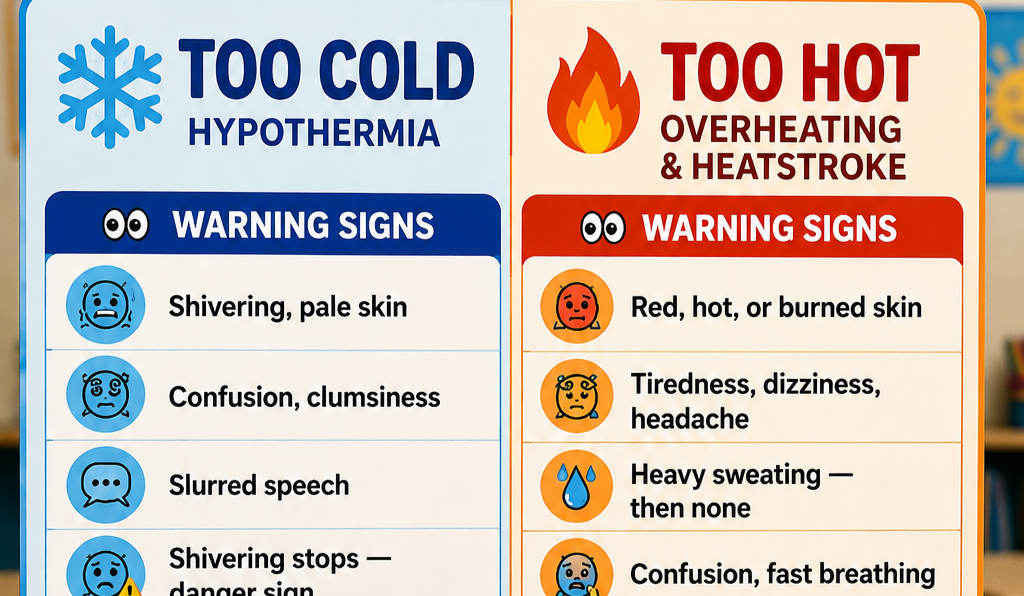
Yesterday TOM climbed into a freezer. Give him a sunny afternoon and he’ll find the opposite kind of trouble — usually with a kitchen condiment involved. Hot and cold emergencies look nothing alike, but people make the same error with both: they panic and overcorrect.
So here’s the whole thing on one screen. Save it, pin it, screenshot it — whatever keeps it handy for the moment you actually need it.
Hot vs. Cold Emergencies
SPOT IT · TREAT IT · KNOW WHEN TO CALL FOR HELP
❄️Too Cold--Hypothermia
👀 Warning signs
Shivering, pale skin
Confusion, clumsiness
Slurred speech
Shivering stops — danger sign
Drowsy or passing out
✅ What to do
Get them somewhere warm
Remove wet clothing
Wrap in dry blankets
Warm (not boiling) drinks if awake
Golden ruleWarm them up slowly. No hot baths or direct heat — sudden warmth shocks the body.
🔥Too Hot--Overheating & Heatstroke
👀 Warning signs
Red, hot, or burned skin
Tiredness, dizziness, headache
Heavy sweating — then none
Confusion, fast breathing
Stops sweating — danger sign
✅ What to do
Move to shade or a cool room
Cool the skin with cool water
Sip water; rest and lie down
Aloe vera for sunburn
Golden ruleCool them gently. No butter, oil, or mayo on burns — greasy things trap heat in.
Either one turning serious — confusion, collapse, no response — means call 999.
From Can You Save TOM? · 50 Hilarious Survival Scenarios
The mirror-image thing is what makes these two easy to remember together. Cold pulls the body’s temperature down until systems slow and stall; heat pushes it up until they overload. And in both, the most alarming sign is the one that looks like relief: the shivering that stops, or the sweating that dries up. Those aren’t the body recovering — they’re the body running out of ways to cope. That’s the moment to treat it as serious.
The treatments mirror each other too. Whatever the temperature did, your job is to move it gently back toward normal — never to slam it the other way. A freezing person doesn’t want a scalding bath; an overheated, sunburned person doesn’t want a greasy coating sealing the heat in. (TOM, naturally, has tried both wrong answers — mayonnaise as sunscreen being a particular low point.)
The one line that covers both
Move them out of the extreme, then warm or cool them gradually. Gentle wins. Sudden loses.
When it stops being a “sit down and recover” situation
Most mild cases — a bit too cold, a bit too hot — settle with shelter, the right gentle treatment, and a little time. The line to watch for is the same on both sides: when someone becomes confused, stops responding normally, has a seizure, or loses consciousness, it’s no longer something to ride out at home.
In a real emergency
For severe cold or severe heat — confusion, collapse, a seizure, or unconsciousness — call 999 straight away and keep gently warming or cooling them while you wait.
Unsure whether it’s serious? NHS 111 can talk you through it.
That’s genuinely the whole framework: know the warning signs, move the person out of the extreme, change their temperature slowly, and call for help when the serious signs appear. Two opposite disasters, one calm response — which, by now, you’ll recognise as the answer to almost everything TOM does.
Want to get latest updates on new books?
SubscRibe to our mailing list below
© 2025. All rights reserved.