
If Someone Is Choking: The Basics
Yesterday TOM met too many marshmallows. Today, the clean version you can actually keep in your head: back blows, abdominal thrusts, and call 999. Save it — it could save a life.
6/14/20262 min read
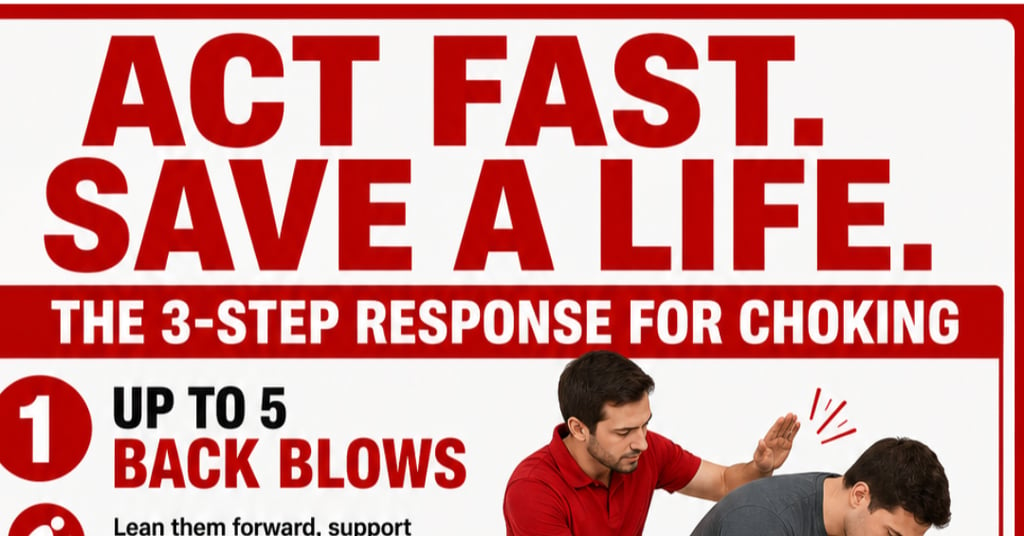

This is the one to actually memorise. Choking is fast and silent — there’s rarely time to look anything up — so the goal is to have the shape of the response already in your head before you ever need it. Here it is, stripped to the essentials.
First, a 2-second check
Can they cough, speak, or breathe? If they can still cough, let them — a strong cough is the most effective way to clear it, so encourage it and don’t intervene. The steps below are for when they can’t cough, speak, or breathe.
The 3-step response
1) Up to 5 Back blows
Lean them forward, support the chest with one hand, and strike firmly between the shoulder blades with the heel of your other hand. Check after each.
2)Up to 5 Abdominal thrusts (Heimlich Maneuver)
Stand behind, arms around the waist, fist just above the belly button, and pull sharply inward and upward. Check after each.
3) 📞 Don’t delay Call 999
If it doesn’t clear, get someone to call 999 (or call yourself), and keep alternating 5 back blows and 5 thrusts until help arrives.
That’s the core loop: 5 back blows, 5 abdominal thrusts, repeat — and call 999 if it doesn’t clear quickly. For a total blockage where they can’t make any sound at all, get someone calling 999 the moment you start, not after.
The one rule to remember
Encourage coughing if they can. If they can’t: 5 back blows, 5 abdominal thrusts, alternate, and call 999. Act — don’t wait for it to clear on its own.
👶 Babies under 1 are different
Never use abdominal thrusts on a baby under one. Use back blows and chest thrusts instead, supporting the head and laying them along your forearm. For young children, use a gentler version of the adult method. The technique for the youngest is genuinely different — an in-person infant first-aid class is the best way to learn it properly.
What not to do
The wrong instincts are the ones that waste seconds. Don’t pour water down their throat — you can’t wash a blockage down, and you risk making things worse. Don’t tell them to “just relax and breathe” — calm doesn’t move a physical obstruction. Don’t do blind finger-sweeps fishing around in the mouth, which can push the object deeper. And don’t wait to see if it sorts itself out. With a blocked airway, doing the right thing quickly beats doing the perfect thing slowly.
UK quick-reference — choking response
Can cough? Encourage it — don’t interfere while the cough is working.
Can’t cough, speak, or breathe? 5 back blows → 5 abdominal thrusts → repeat.
Call 999 if it doesn’t clear, or immediately for a total blockage. Get a bystander to call while you act.
Babies under 1: back blows + chest thrusts, never abdominal. Children: gentler version of the adult method.
If they become unconscious: lower them safely, call 999, and start CPR.
In a real emergency
Choking is time-critical. If someone can’t breathe, cough, or speak, start back blows and abdominal thrusts immediately and get someone to call 999 right away.
This card is a memory aid, not a substitute for training. A short in-person first-aid course is the single best thing you can do — book one if you can.
Three steps, one quick check, and a clear “don’t” list. Print it, pin it, stick it inside a kitchen cupboard — wherever you’ll picture it under pressure. It’s the rare bit of TOM you sincerely hope never to use, and exactly the bit you’ll be most relieved to know. Share it with someone today; it’s the kind of thing that travels well.
Want to get latest updates on new books?
SubscRibe to our mailing list below
© 2025. All rights reserved.