Meet TOM — The Hero Who Can't Help Himself
He ate 37 gummy vitamins. He tried to pet a wild snake named Gary. He is not the brightest marshmallow in the bunch. And he really, really needs your help.
First Aid · Family Fun · Kids Books
4 min read
"I'm no survival expert. I'm barely human. Don't copy me." — TOM
If you've ever watched someone make a spectacularly avoidable mistake and thought "well, at least I know what NOT to do now" — congratulations. You already understand the core philosophy of Can You Save TOM?
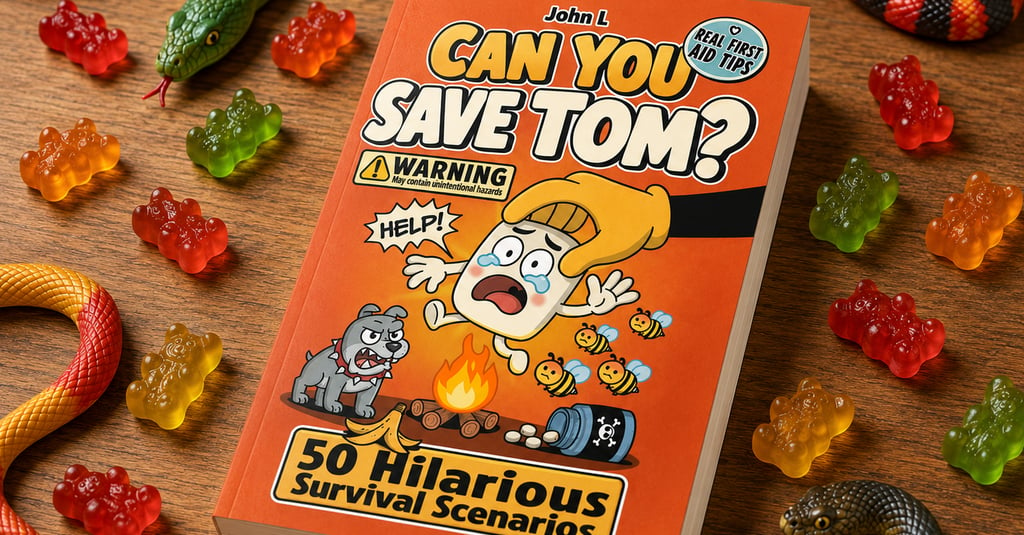
This new interactive book by John L introduces us to TOM: a lovably clumsy, enthusiastically terrible decision-maker who needs your help to survive fifty of the most ridiculous emergencies you've ever read about. And somehow — amid all the gummy vitamin mishaps and wild snake friendships — you'll actually pick up some genuinely useful first aid knowledge along the way.
.Your job? Save him.
What exactly is this book?
Think of it as a choose-your-own-adventure game — but the adventure is surviving TOM's terrible decision-making. Each chapter drops you into a new disaster scenario. TOM is in trouble. You get a handful of options. You pick one. Then you find out whether you just saved TOM… or made things significantly, comically worse.
It's packed with lame jokes (intentionally lame — the best kind), goofy riddles, silly drawing prompts, and a scoring system that tracks how good a TOM-Saver you really are. At the end of the book, you add it all up to discover whether you're a true Tom-Saving Legend — or whether you're just as doomed as he is.
There are also QR codes scattered throughout. Scan them with your phone and you'll land on trusted, real-world safety resources — videos and guides from health and safety organisations that go deeper on whatever chaos TOM just put himself through. Learning safety tips that actually stick, packaged as comedy. It works better than you'd think.
Chapter 1: The Gummy Disaster
Every adventure needs an origin story, and TOM's starts here. TOM found a bottle of gummy vitamins. They looked delicious. So, obviously, he ate 37 of them.
Now he's lying on the couch, moaning — and he just asked if he's turning into a blueberry.
What should you do? Here are the four options the book gives you:
A) Make him run around the garden to burn it off
B) Give him a big glass of milk and call Poison Control Correct ✓
C) Tell him to throw up in a bucket
D) Let him sleep it off
If you picked B — well done. Vitamins can cause a dangerous build-up of iron or Vitamin A, which can affect the liver and stomach. Milk can help a little, but professional advice is always the right first call. And Option C — making him throw up — is actually worse. It can cause additional damage on the way back up.
💡 The Real Lesson from Chapter 1
Some vitamins — particularly Vitamin A, D, E, K, and iron — are fat-soluble and can build up in the body if taken in large quantities. They don't just "leave" the way Vitamin C does. If a child gets into a vitamin bottle, call Poison Control immediately rather than waiting to see what happens or trying home remedies.
What if you picked wrong?
The book doesn't just tell you you're wrong and move on. Each incorrect answer gets its own mini-consequence — a short, ridiculous description of what happens to TOM when you make the wrong call.
Pick A (the garden run) and TOM makes it three steps before collapsing dramatically onto a trampoline. Pick C (the bucket) and Tom is now doubled over in a considerably worse state. Pick D and you relax, until 6am, when you're woken up by the sound of sirens.
It's the kind of wrong-answer feedback that makes you want to read every option just to see what happens — which, of course, also means you absorb the information more thoroughly.
Vitamins: helpful or harmful?
After the scenario, each chapter includes a short educational section — the real-world context behind TOM's chaos. Chapter 1's explainer breaks down how vitamins work in the body, which ones are water-soluble (and pass harmlessly through the body when you've had too much) versus which ones are fat-soluble and can accumulate.
1) Most vitamins are helpful — when you get them from food. Fruit, vegetables, meat and dairy cover most of what the body needs.
2) Fat-soluble vitamins (A, D, E, K) and iron can build up in the body. Taking too much over time — or a large amount at once — can be dangerous.
3) Gummy vitamins are particularly risky for young children because they look and taste like sweets. The book's practical tip: write "NOT CANDY" on the bottle.
4) If someone takes too many vitamins, call Poison Control first. Don't wait, don't induce vomiting, don't try to guess whether it's serious.
⚠️ Poison Control (UK & Ireland)
In the UK, call 111 (NHS) or 999 in an emergency. Your pharmacist can also advise on minor overdoses. Save the number now — before you need it. TOM-approved advice.
Why does this approach work?
First aid education for children has a longstanding problem: it's either dull enough to forget immediately, or so frightening that kids switch off. Can You Save TOM? sidesteps both traps.
By wrapping the lesson in a scenario where you make the choice, the information goes in differently. You're not passively reading a fact — you're solving a problem. And because the wrong answers are funny rather than scary, there's no anxiety attached to getting it wrong. You just laugh, learn what actually works, and read on.
The research on this is solid: learning tied to emotion and story is retained far more reliably than dry fact-delivery. TOM turns out to be an excellent teaching assistant, even if he's a terrible patient.
Available Now On Amazon.
Can You Save TOM?
50 Hiarious Survival Scenarios
By John L — perfect for kids aged 8+, families, and anyone who loves learning the hard way (through TOM's mistakes, not their own).
What's coming next?
TOM's troubles are just getting started. Over the next 50 chapters, he will attempt DIY dentistry with pliers, befriend a wild snake named Gary, microwave a metal spoon "just to see what happens", and — in one particularly memorable chapter — decide that toothpaste is an appropriate substitute for a fire extinguisher.
Each chapter follows the same pattern: the scenario, your choices, the consequences (good and terrible), and the real educational section underneath. Some are funny. Some are genuinely useful. All of them are more memorable than a standard first aid leaflet.
We'll be posting a new chapter breakdown every few days. Save this blog, follow along on Pinterest, and see if you can do better than TOM — which, honestly, is a low bar, but still worth aiming for.
Want to get latest updates on new books?
SubscRibe to our mailing list below
© 2025. All rights reserved.