The Air Freshener Incident 💨
TOM thought it would be funny to spray air freshener while holding a candle. His eyebrows had opinions. Chapter 18 is a masterclass in what happens when aerosol meets flame.
6/29/20266 min read
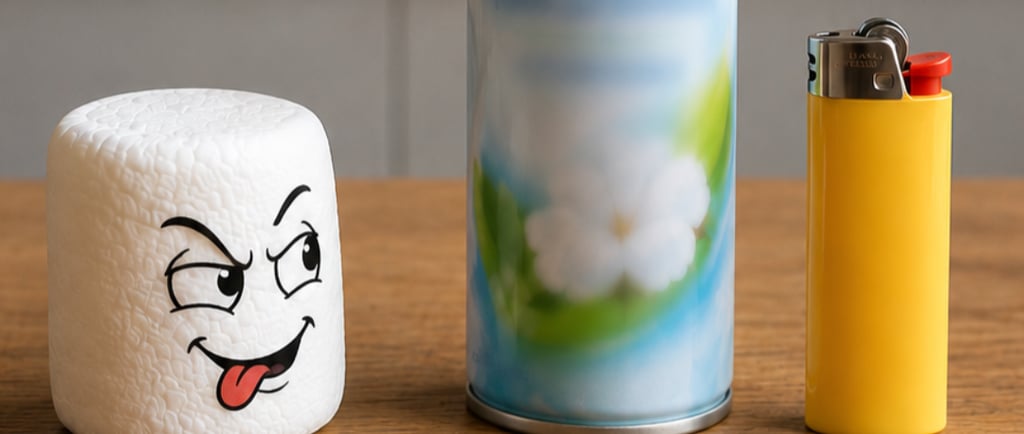
There are many ways to freshen a room. Opening a window. Lighting a candle. What TOM did was combine the second option with an aerosol can — at close range — in what he described afterwards as "a bit of fun." His eyebrows described it differently.
Chapter 18 of Can You Save TOM? arrives at a junction most of us have never approached, because most of us understand on some instinctive level that flammable spray and open flame is a combination best left unexplored. TOM does not have this instinct. TOM has enthusiasm, curiosity, and singed eyebrows.
📖 Chapter 18 — The Scenario
TOM thought it would be funny to spray air freshener while holding a candle. Boom. Now his eyebrows are singed and he's blinking in confusion. The lavender scent, at least, is excellent. What should you do?
A) Slap him with a wet towelHe's singed, not on fire. A wet towel slap is not a recognised first aid technique. TOM does not need percussive maintenance.
B)Blow on his face and screamBlowing on a fireball is not heroic. It's just weird. Also ineffective. Screaming, while understandable, also does not help.
C)Put out any flames, then cool and treat the burns gentlyRemove the source of harm first, then address the injury. Cool water, not butter. This is correct.
D) Try to recreate the moment for TikTokYou went viral. So did the flames. TOM's eyebrows are not content. They are a medical situation.
Option C is correct, and the logic is simple even if TOM's reasoning wasn't: eliminate the hazard first, then treat the injury. The aerosol needs to be out of the picture, any flames need to be extinguished, and then — and only then — you deal with what the flames left behind. Aerosol spray + open flame creates an instantaneous fireball. It doesn't linger. But the burn it causes absolutely does.
💡 The Core Rule
For burns: put out flames first, then cool the skin under clean, cool running water for at least 10 minutes. Never use butter, toothpaste, or oils — they trap heat and make things worse. If the burn is larger than the palm of your hand, or on the face, hands, or joints, get medical help.
What if you picked the wrong answer?
💦 Option A: The Wet Towel SlapCongratulations. He's now wet and singed. The burn hasn't been cooled properly, TOM is confused and damp, and the candle is still a hazard. 0 points.
🌬️ Option B: Blow on His Face and ScreamBlowing on a fireball isn't heroic. It's just weird. The burn still needs treating, and TOM is now also slightly offended. 0 points.
📸 Option D: TikTok DocumentationYou went viral. So did the flames. TOM's eyebrows are not content — they are a medical situation requiring actual first aid. 0 points. Incredible footage, though.
🔥 Flammable sprays: instant fireballs, explained
Most people know that aerosol cans carry a flammable warning symbol. Fewer people have stopped to think about why — or what "flammable" actually means in practice when the can is pointed at a lit candle.
Aerosol products — air fresheners, hairspray, deodorant, cleaning sprays — contain two components: the product itself, and a propellant that delivers it as a fine mist. Those propellants are typically gases like butane, isobutane, or propane. They're what makes the spray come out evenly. They're also highly flammable.
When those gases meet an open flame, they ignite instantly. Not slowly, not gradually — instantly. The fine mist creates a large surface area for the reaction, which is why the result is a fireball rather than a slow burn. It doesn't last long. But it doesn't need to. A fraction of a second is more than enough to singe hair, eyebrows, or skin.
Beyond the immediate burn risk, there's a secondary hazard: if the can itself gets hot enough — from an external flame or from being in a fire — the pressure inside can build until the can fails. Aerosol cans should never be stored near heat sources or thrown into fires for exactly this reason.
The "flammable" symbol on the side of a can isn't legal small print. It's describing actual chemistry. TOM read it as a suggestion.
🔎 Fire Safety Challenge — From the Book
Spot the Fire Hazards
Look around the room you're in right now. Can you spot 3 things that should never be near an open flame? The book suggests starting with the obvious ones:
Paper and cardboard — ignites quickly and spreads fast
Aerosol cans — air freshener, hairspray, deodorant, cleaning products
Curtains and fabric near candles or cookers
Loose clothing near gas hobs
Anything with a flammable warning symbol (🔥) on the label
This is one of the best habits you can build — a quick mental scan whenever you're using a flame or heat source. TOM never did this scan. This is Chapter 18.
How to treat a burn — the right way
Burns are one of those injuries where the instinctive response is often exactly wrong. The urge to put something soothing on a burn — butter, toothpaste, oil, cream — is understandable. These things feel cooling on normal skin. On a burn, they trap heat against the tissue and make the damage worse. The only thing that should go on a fresh burn is cool running water.
Remove the source — put out any flames firstBefore anything else, make sure the fire hazard is gone. The aerosol, the candle, the flame — all of it. You can't treat a burn while the burning is still happening.
Cool the burn with clean, cool running water for at least 10 minutesNot ice, not ice-cold water — cool running water. Ice can damage the skin further. 10 minutes is the minimum. A timer helps because 10 minutes feels much longer than it is.
Remove jewellery or clothing near the burn — but not if it's stuckRings and watches near a burnt area can cause problems as swelling sets in. But if clothing is stuck to the skin, leave it. Don't pull.
Cover loosely with cling film or a clean non-fluffy dressingCling film is ideal — it doesn't stick to the wound and keeps it clean. No cotton wool or fluffy materials that can shed fibres into the burn.
Get medical help if the burn is seriousSee below for the specific signs that mean this needs professional attention rather than home treatment.
🚫 Never Put These on a Burn
Butter or oils — trap heat against the skin, slow down cooling, increase infection risk
Toothpaste — same problem, plus it introduces bacteria and irritants
Ice or ice-cold water — can cause ice burns and shock the skin further
Fluffy materials (cotton wool, towels) — fibres can embed in the wound
Popping blisters — blisters protect the healing skin beneath. Leave them alone.
🇬🇧 UK Context — When to Get Help
Call 999 or go to A&E if: the burn is larger than the palm of TOM's hand, it's on the face, hands, feet, genitals, or a major joint, or the skin looks white, brown, or black (deep burn)
Call NHS 111 if you're unsure whether the burn needs professional attention — they'll advise
Chemical burns (cleaning products, etc.) follow the same cool-water rule, but irrigate for longer — 20 minutes minimum — and always seek medical review
Facial burns from aerosol fireballs — as in TOM's case — should always be checked medically, even if they seem minor. Eyes and airways can be affected.
The broader lesson from Chapter 18
TOM's aerosol incident is funny in the way only TOM's disasters can be — because everyone reading it has had a moment of knowing something was a bad idea and doing it anyway. The gap between "this is probably fine" and "this is absolutely not fine" is smaller than we think when it comes to fire hazards.
The practical takeaway from Chapter 18 has two parts. First: aerosol cans and open flames do not belong in the same moment, full stop. Second: if a burn does happen — whether from a TOM-style experiment or a far more ordinary kitchen accident — cool water is the answer, and it needs to run for longer than feels necessary.
The fire safety scan exercise from the book is genuinely worth doing once. Not because you're planning a TOM-style experiment, but because most fire hazards in the home are hiding in plain sight, on shelves we walk past every day without a second thought.
🚨 In a Real Emergency
If clothing is on fire: Stop, Drop, Roll. Don't run — running fans the flames. If someone else is on fire, use a heavy blanket or coat to smother the flames. Cool the burn with running water immediately once the fire is out. Call 999 for anything beyond a very minor burn. Do not leave the person alone while waiting for help.
Want to get latest updates on new books?
SubscRibe to our mailing list below
© 2025. All rights reserved.