
The Battery Test 🔋⚡
TOM wanted to know if a 9-volt battery really zaps you. He licked it. Now he's twitching and shouting "I CAN FEEL ELECTRICITY." Chapter 23 — what to do, and why a car battery is not an upgrade.
7/6/20264 min read
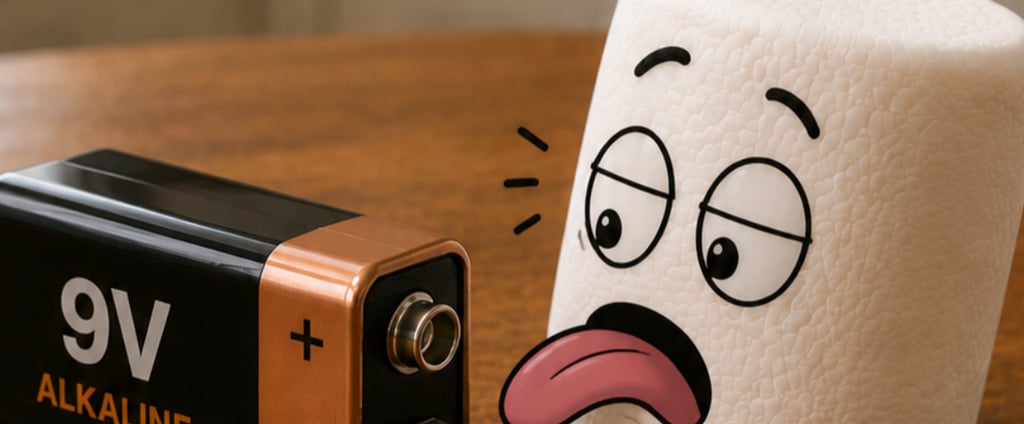
The question of whether a 9-volt battery zaps your tongue is one of those things most people know the answer to without having to test it. TOM is not most people. TOM is a person for whom "probably" is insufficient and "let's find out" is an entirely valid scientific method. Chapter 23 opens with TOM already twitching, which tells you how the experiment concluded.
The good news is that a 9-volt battery licked by a human tongue is uncomfortable and surprising, but not dangerous. The less good news is that TOM has now suggested escalating to a car battery, which is a very different situation and the answer to which is an unambiguous no.
📖 Chapter 23 — The Scenario
TOM wanted to know if a 9-volt battery really zaps you. He licked it. Now he's twitching slightly and shouting "I CAN FEEL ELECTRICITY" with an expression somewhere between horror and delight. What should you do?
A)Laugh Laughing while someone twitches? Dark. Also unhelpful. TOM needs a quick check, not an audience. 0 points.
B)Make sure he's okay, rinse his mouth, and monitor 9V is low voltage, but still dumb. Rinse the mouth with water, check he's genuinely fine, and watch for any odd symptoms. This is the correct response.
C) Make him lick a car battery A car battery is 12 volts of direct current with serious current capacity. That's not an upgrade — that's a hospital visit. Absolutely not. 0 points.
D) Use him to power the TV remote The TV's still dead, and now so is TOM's tongue. This solves nothing and adds insult to electrical injury. 0 points.
Option B is correct. A 9-volt battery produces a mild but very real electrical sensation when its two terminals contact the wet surface of the tongue — the saliva conducts the current, and the tongue's density of nerve endings makes it acutely sensitive to it. It's harmless at that voltage, but the correct response is still a calm check: rinse the mouth, confirm there's no unusual reaction (numbness that persists, burning, or any sign he's touched something other than a standard 9V), and monitor briefly. Laughter — while understandable — is option A and scores zero.
💡 The Core Rule
9-volt battery lick: rinse the mouth with water, check TOM is genuinely fine, and monitor briefly for any unusual symptoms. The sensation is real but the voltage is low. If anything other than a standard small battery was involved, or if symptoms persist, get medical advice. And do not suggest the car battery.
What if you picked the wrong answer?
😂Option A: LaughLaughing while someone twitches is, as the book notes, dark. TOM did not feel supported. The twitching continued unmonitored. 0 points.
🚗Option C: Car BatteryA car battery is not an upgrade. 12 volts with substantial current capacity is a genuine electrical hazard. TOM briefly considered this option himself before being firmly redirected. 0 points.
🔋Option D: Power the TV RemoteThe TV is still dead. TOM's tongue is now also dead — metaphorically. The remote requires AA batteries, not TOM. This experiment failed on multiple levels. 0 points.
🔋TOM's Tip — Chapter 23
"Batteries are for remotes, not tongues."
The science of why it zaps
🔬 Why the 9V Battery Tongue Test Works (and Why It Stops There)
A 9-volt battery has its positive and negative terminals on the same end — unusually close together. When you press both terminals against your tongue simultaneously, the saliva (which is a reasonable electrical conductor due to dissolved salts) completes the circuit. Current flows between the terminals through the wet tissue of the tongue.
The tongue is one of the most nerve-dense areas of the body. Even the small current produced by a 9V battery is enough to stimulate those nerves — producing the sharp, metallic zap TOM was so enthusiastically reporting. There's also a mild chemical reaction as the current electrolyses the saliva, which contributes to the metallic taste.
At 9 volts and with the small current a standard battery can deliver, this is genuinely uncomfortable but not dangerous for a healthy adult. The sensation is real — TOM was not exaggerating — but it causes no lasting harm. The situation changes significantly with higher voltages or higher current sources, which is why Option C (car battery) is off the table entirely.
Not all batteries are the same
🔋AA / AAA / C / D
1.5V each. Too low to complete a useful circuit through skin. No noticeable zap. Won't power TOM either.
🔋9-volt battery
9V . Both terminals close together. Will zap a wet tongue. Uncomfortable and dumb, but not dangerous at this voltage.
🚗
Car battery. 12V + high current
Voltage alone is manageable, but the current a car battery can deliver is not. Serious burn and shock risk. Not an experiment. Ever.
🚨 When It's Not Just a Zap
If someone has had contact with mains electricity (wall sockets, appliances), a car battery, or any industrial power source — this is not a Chapter 23 situation. Call 999. Do not touch the person if they may still be in contact with the source. Electrical injuries can cause internal damage that isn't visible on the surface. Always seek medical assessment for anything beyond a standard small battery.
⚡ Battery Safety — The Practical Bits
Button batteries are a separate and serious hazard — if swallowed by a child, call 999 immediately. They cause chemical burns in the oesophagus within 2 hours. This is not a wait-and-see situation.
Store 9-volt batteries with a cap or tape over the terminals — loose batteries in a drawer can short-circuit against metal objects and cause fires
Don't put batteries in a fire or attempt to recharge non-rechargeable batteries — both can cause them to rupture
If a battery has leaked (white or blue residue), don't touch it with bare hands — wear gloves, dispose carefully, and wash hands thoroughly
TOM's experiment aside: the 9V tongue test is a rite of passage for many people. It's still dumb. Don't encourage it.
The bigger lesson from Chapter 23
Chapter 23 is one of the lighter entries in the Can You Save TOM? series — TOM's experiment was essentially successful (he now knows the answer) and the consequences were mild. But it sits alongside the button battery note in the fact box for a reason: the gap between "harmless" and "serious" in the world of electrical hazards is defined by voltage and current, and those numbers aren't visible on the outside of a battery.
A 9-volt is uncomfortable. A car battery is dangerous. A mains socket is an emergency. The instinct that made licking the 9V seem like a reasonable experiment is the same instinct that would need to be firmly overruled at higher voltages — and Chapter 23's job is to plant that distinction clearly enough that it sticks.
TOM's tip says it simply: batteries are for remotes, not tongues. He earned the right to that opinion.
Want to get latest updates on new books?
SubscRibe to our mailing list below
© 2025. All rights reserved.