
The Choking Challenge: You Have Seconds
TOM tried to fit as many marshmallows in his mouth as possible. Spoiler: too many. He’s coughing and grabbing his throat — and this is the chapter we’d urge every single reader to actually learn.
6/13/20264 min read
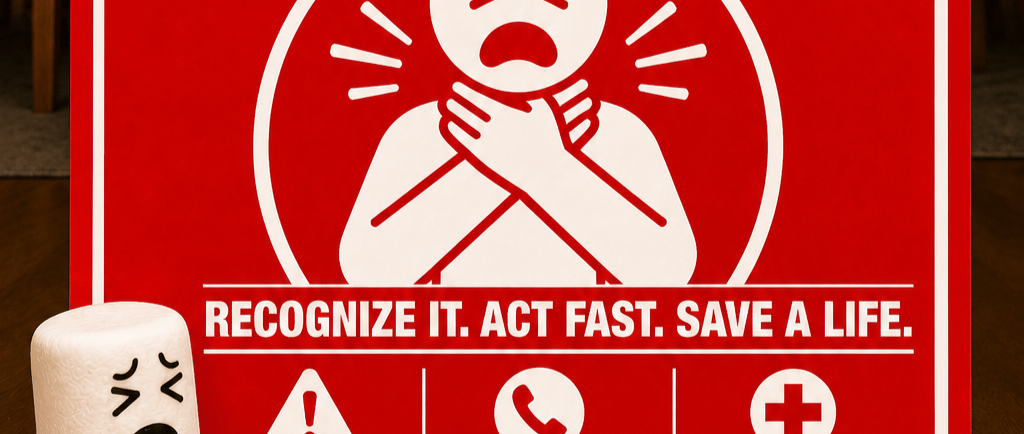
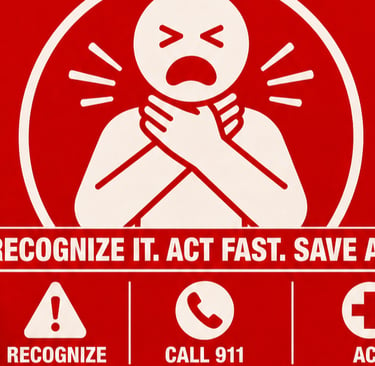
We make a lot of jokes in this series, because that’s how the lessons stick. This one we’ll play a little straighter — not because TOM’s marshmallow challenge isn’t deeply silly, but because choking is fast, quiet, and genuinely dangerous, and the few seconds of knowing what to do can be the whole difference. If you read one chapter’s worth of this properly, make it this one.
TOM, naturally, got here by trying to set a personal marshmallow record. The cause is comic; the situation is not. He’s coughing and clutching his throat — so what do you do?
Straight from the book
“Tom decided to see how many marshmallows he could fit in his mouth. Spoiler: too many. Now he’s coughing and grabbing his throat.”
A)Do the Heimlich manoeuvre (abdominal thrusts)
B)Hit him on the back as hard as possible
C)Pour water down his throat
D)Tell him to breathe deeply and relax
The book’s answer is A — act immediately to clear the airway with abdominal thrusts, rather than giving water or waiting for it to pass. The key idea it’s drilling in is the right one: do something, now. A blocked airway doesn’t fix itself, and the wrong answers all waste the seconds that matter.
If you picked wrong…
B — A random full-force whack is not the technique — in the book, you smack him so hard he swallows the problem (and a molar). Back blows are real, but they have a proper method.
C — Now he’s choking and coughing water everywhere. Never pour liquid into a blocked airway.
D — “Just breathe and relax” does nothing when the airway is physically blocked. Calm doesn’t clear an obstruction.
First, recognise it: partial vs total blockage
Before any technique, you need to read the situation — because the response depends on it. Choking happens when food slips into the windpipe (the air tube) instead of the food pipe. A small flap called the epiglottis normally covers the windpipe when you swallow, but laughing, talking, or stuffing in too much at once can mistime it.
Partial blockage
They can cough
Loud coughing, maybe some wheezing — air is still getting through. Encourage them to keep coughing; a strong cough is the best way to shift it. Don’t slap their back while they’re coughing effectively.
Total blockage
No air, no sound
They can’t cough, speak, or breathe, may clutch their throat and panic. This is the emergency — act immediately with back blows and thrusts, and get someone to call 999.
The response (current UK guidance)
One thing worth knowing: the book jumps straight to abdominal thrusts, but the standard UK sequence taught by the NHS, Red Cross and St John Ambulance starts with back blows first, then thrusts, alternating. The book’s instinct — act fast to clear the airway — is exactly right; here’s the full ordered version to lock in.
Encourage coughing. If they can still cough, let them — it’s the most effective thing. Only step in if the cough is weak or stops.
Give up to 5 back blows. Lean them forward, support their chest with one hand, and strike firmly between the shoulder blades with the heel of your other hand. Check after each one.
Give up to 5 abdominal thrusts. Stand behind, wrap your arms around their waist, make a fist just above the belly button, and pull sharply inward and upward. Check after each.
Alternate and call 999. Repeat 5 back blows and 5 thrusts. If it doesn’t clear quickly, call 999 (or have someone call immediately) and keep going until help arrives.
If they go unconscious: lower them safely, call 999 if not already done, and begin CPR.
Important: it’s different for babies
For a baby under 1, do not use abdominal thrusts. Use back blows and chest thrusts instead. For young children, use a gentler version of the adult technique. A proper class is the best way to learn the difference safely.
UK quick-reference — choking
Can cough? Encourage coughing — don’t intervene while it’s working.
Can’t cough, speak, or breathe? 5 back blows, then 5 abdominal thrusts, alternating.
Call 999 if the blockage doesn’t clear quickly, or straight away for a total blockage — get a bystander to call while you act.
Adults & children over 1: back blows + abdominal thrusts. Babies under 1: back blows + chest thrusts, never abdominal.
Don’t: pour water, say “just breathe,” do blind finger-sweeps, or wait for it to fix itself.
The book points readers to a calm, safe Heimlich demonstration by the Red Cross via its QR code — and honestly, that’s the right move for all of us. Reading the steps builds the map; watching it done, or taking a short in-person first-aid course, is what makes your hands actually know what to do under pressure.
In a real emergency
Choking is a time-critical emergency. If someone can’t breathe, cough, or speak, start back blows and abdominal thrusts immediately and get someone to call 999 straight away.
If they become unconscious, begin CPR. Don’t wait, and don’t leave them alone to make the call if anyone else is around to do it.
TOM, mercifully, survives his marshmallow ambition — but this is the chapter that earns the whole book its place on the shelf. It takes something genuinely frightening and makes it familiar enough that a child remembers the shape of the response. Learn it properly, watch a demo, and if you can, take a class. It’s the rare TOM lesson you hope you never need and will be endlessly glad to have. Tomorrow we’ll lay out the three core steps as a clean, save-it-now card.
Want to get latest updates on new books?
SubscRibe to our mailing list below
© 2025. All rights reserved.