The Microwave Metal Mistake
TOM put a metal spoon in the microwave "just to see what happens." Reader, chaos happened.
6/23/20264 min read
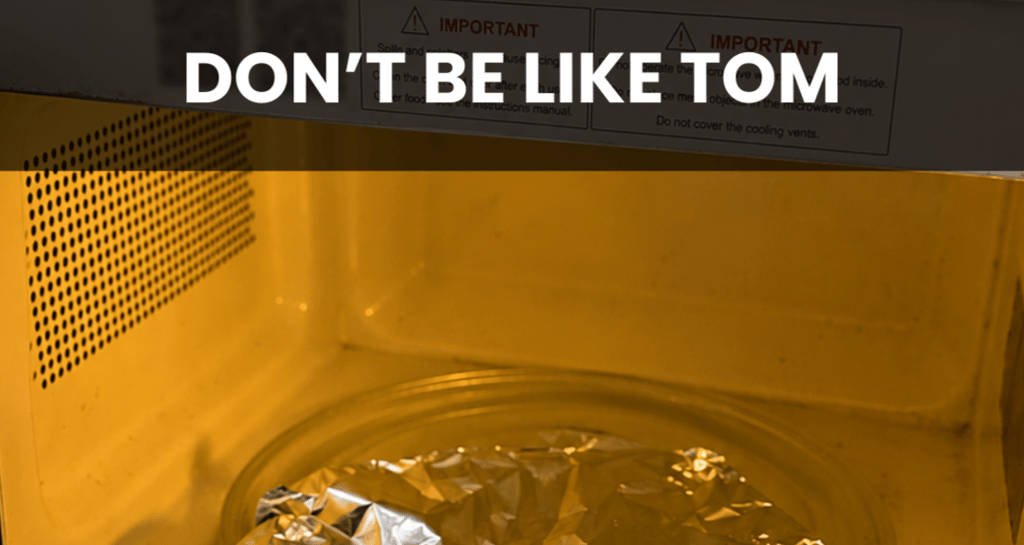
There is a question that has haunted philosophers, scientists, and curious toddlers for generations: what does happen if you put metal in the microwave? TOM decided the only way to find out was to conduct a live experiment. In his kitchen. Alone. With a spoon.
Chapter 17 of Can You Save TOM? is many things. It is a kitchen safety lesson. It is a masterclass in scientific curiosity gone badly wrong. And it is, above all, a reminder that "just to see what happens" is never, ever an acceptable reason to do something near an appliance.
Let's set the scene — and then work out what you should have done instead.
The Scenario 🍴
📖 Chapter 17 — Can You Save TOM?
TOM is heating up his soup when he spots the metal spoon resting on the counter. The microwave is already running. "I wonder," TOM thinks, with the confidence of a man who has never once Googled anything, "what would happen if I popped this in there." He opens the door mid-cycle. He places the spoon inside. He presses start. What happens next is best described as a light show — spectacular, loud, and extremely difficult to explain to the landlord.
Your job, as always, is to choose better than TOM did. Here are your four options for the moment TOM spots the spoon:
A)Put the spoon in and watch through the window to see what happens
B )Leave the spoon on the counter — never put metal in a microwave
C)Put it in quickly and take it out before anything goes wrong
D) Ask TOM to try it first while you stand back
✅ The Rule
Metal and microwaves do not mix — ever. Not briefly. Not with supervision. Not out of scientific curiosity. The spoon stays on the counter. Always.
What Went Wrong for TOM 💥
If you chose A — watch through the window:The arcing starts within seconds. TOM's microwave produces a dramatic spark display — more fireworks than kitchen appliance. The magnetron is fried. The soup is still cold. TOM is grounded by his own landlord.
If you chose C — in and out quickly:There is no "quickly" when metal meets microwave radiation. The arc forms the instant the cycle begins. TOM's hand is near the door, the sparks are already going, and the soup remains at exactly the temperature it started. Nothing about this went according to plan.
If you chose D — let TOM try first:You have now made TOM the test subject for a domestic appliance experiment. This is not better. This is arguably worse. TOM's expression as the sparks fly will haunt you. You are both standing in a smoky kitchen with a broken microwave and no soup.
Why Metal and Microwaves Don't Mix ⚡
Microwave ovens work by producing electromagnetic radiation — specifically, microwaves — that cause water molecules in food to vibrate rapidly, generating heat. This is elegant, efficient, and completely incompatible with metal.
When metal is placed inside a microwave, the electromagnetic field causes electrons in the metal to move rapidly, creating an electrical current. If the piece of metal has a sharp edge or point — like a fork tine or the bowl of a spoon — the charge concentrates at that point and can produce electrical arcing: those dramatic visible sparks TOM enjoyed so much from the wrong end of.
The arcing can damage or destroy the microwave's magnetron (the component that generates the microwaves), scorch the interior of the appliance, and in worst cases, cause a fire. None of these outcomes improve the soup.
What to Do If It Happens Anyway 🔥
Press stop immediately. If you realise metal is inside the microwave while it is running, press stop or open the door right away. The arcing stops the moment the microwave cycle ends.
Do not reach inside while it's running. Wait until the microwave has fully stopped before opening the door and removing anything.
Check for scorch marks. Inspect the interior of the microwave for burn marks or damage to the interior walls or the magnetron cover. A scorched interior doesn't always mean the appliance is broken, but it's worth checking.
If there's any smoke or smell of burning, unplug it. Do not continue using a microwave that has visibly sparked until you're confident there's no internal damage. If in doubt, stop using it and get it checked.
If a fire starts, do not open the door. Opening the door feeds oxygen to the fire. Keep the door shut, unplug at the wall if safe to do so, and call 999 if the fire doesn't extinguish itself when the microwave is off.
UK Kitchen Safety
Kitchen fires are the most common type of house fire in the UK. The majority are caused by unattended cooking, overheated fat, or — yes — incorrect microwave use. If a kitchen fire starts and you cannot safely extinguish it, leave the room, close the door to contain the fire, and call 999 immediately.
For small, contained fires (such as a microwave interior fire that is not spreading), turning off and unplugging the appliance is usually sufficient. For anything larger, get out and call for help.
The Broader Lesson: Read Before You Experiment
TOM's defining characteristic — across all 50 chapters — is that he approaches every situation with complete confidence and zero prior research. He doesn't read manuals. He doesn't check instructions. He doesn't ask. He simply acts, with the cheerful certainty of someone who has never once been wrong before (despite all available evidence to the contrary).
The microwave spoon incident is TOM at his most TOM. He knew there might be a reason people don't put metal in microwaves. He just assumed that reason wouldn't apply to him, today, with this particular spoon. It applied. It always applies.
The rule here isn't really about microwaves. It's about the dangerous confidence of thinking you can safely break a safety rule "just this once" to satisfy your curiosity. Some experiments are fine to run. This one, like most of TOM's, genuinely isn't.
⚠️ In a Real Emergency
If a microwave catches fire: keep the door closed, unplug the appliance at the wall if it is safe to do so, and evacuate the kitchen. Call 999 if the fire is not immediately contained. Do not use water on an electrical fire.
Want to get latest updates on new books?
SubscRibe to our mailing list below
© 2025. All rights reserved.