
The Superglue Situation 🖐️
TOM glued his hand to his face. This was not the plan. Chapter 19 covers what to actually do when superglue bonds skin — and what definitely not to do.
6/29/20265 min read
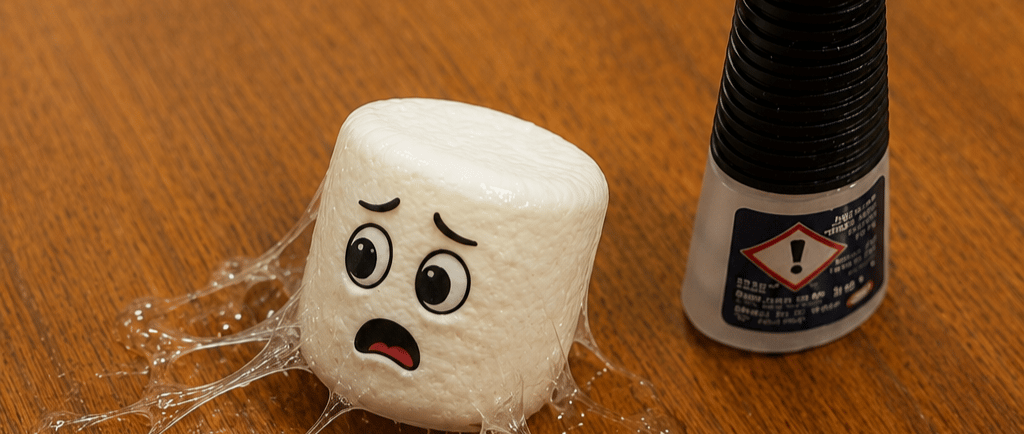
Superglue is one of those products that feels perfectly safe right up until the moment it very much isn't. It's sitting in a drawer somewhere in almost every household. It dries in seconds. It bonds almost anything. Including, as TOM discovered in Chapter 19, a hand to a face.
The specific circumstances of how TOM achieved this are between TOM and his toolbox. What matters is what comes next — because superglue on skin is more common than you'd think, and the instinctive responses (pull, pick, panic) are precisely the wrong ones.
📖 Chapter 19 — The Scenario
TOM was doing a spot of DIY. TOM was using superglue. TOM, in a moment of either clumsiness or bold experimentation, has now glued his hand firmly to his cheek. He is standing very still. He is thinking. The superglue is not thinking — it has already made up its mind. What should you do?
A) Pull the hand away as fast as possibleTearing bonded skin causes more damage than the glue itself. Do not pull. TOM's cheek would like to stay attached to TOM's face.
B) Soak the area in warm soapy water and ease apart gentlyWarm water softens the bond gradually. Soap helps. Time helps. Patience — which TOM does not have — also helps.
C) Use nail polish remover (acetone) immediately and aggressivelyAcetone can work, but not on the face, not near the eyes, and not as a first resort. It can cause skin and eye irritation, especially in a panic-fuelled scrubbing session.
D) Ask TOM to sneeze really hardThis was evaluated. It does not work. It does make the situation funnier, briefly. 0 points.
Option B is correct. Warm soapy water is the right first move for superglue on skin — it's safe, it's available in any home, and it works by softening the cyanoacrylate bond without the irritation risk of solvents. The key word in the instruction is gently. Easing apart, not tearing. If warm water alone isn't doing it after several minutes, you can progress to other options — but pulling is never one of them.
💡 The Core Rule
Superglue on skin: don't pull. Soak in warm soapy water and ease apart gently. If bonded to eyes, lips, or eyelids — don't attempt to separate. Go straight to A&E.
What happens with the wrong choice?
😬 Option A: Pulls Away FastSuperglue bonds are stronger than the surface skin layer. Pulling causes the skin to tear, not the glue bond to release. TOM now has a skin tear as well as a superglue situation. 0 points. The DIY project remains unfinished.
😤 Option C: Aggressive Acetone ApplicationNear the eyes or on sensitive facial skin, acetone can cause significant irritation and chemical burns if applied carelessly. The correct approach uses it sparingly, if at all, and only away from eyes and mucous membranes. Aggressive use near the face is a second problem on top of the first. 0 points.
🤧Option D: The Sneeze StrategyTOM attempted this. The superglue was unimpressed. His hand remains attached to his face. A sneeze exerts approximately 100mph of force through the nose — none of which travels usefully to a hand-cheek bond. 0 points. Bless him.
Why superglue is surprisingly tricky
Superglue — cyanoacrylate adhesive, to use its proper name — works by reacting rapidly with moisture. The moisture on your skin, as it happens, is an excellent trigger. This is why superglue bonds skin so much faster and more effectively than it sometimes bonds the things you actually want to glue together. The chemistry is doing exactly what it's designed to do. It's just doing it to TOM's face.
The bond it creates is strong in the sense that it resists pulling — but it's also brittle, and it degrades with moisture and heat over time. This is the key to the warm-water approach: you're not dissolving the glue so much as weakening the interface between the glue and the skin by introducing moisture and gentle warmth. Given time — and we're talking minutes here, not hours — this works reliably for skin-to-skin bonds.
The situation changes significantly when superglue reaches the eyes, lips, or eyelids. These areas have mucous membranes that react very differently to cyanoacrylate, and attempting to peel or separate them at home carries real risk of injury. For anything near the face — especially the eyes — the answer is professional medical help, not DIY resolution.
The step-by-step response
Do not pullRepeat this to yourself and to TOM. The instinct is to pull. Resist it. Tearing bonded skin causes injury; the glue bond itself is survivable.
Soak in warm (not hot) soapy waterA bowl of warm water with a little washing-up liquid. Submerge the bonded area and leave it for several minutes. Don't scrub — just soak and wait.
Ease apart gently with a rocking motionOnce the water has had time to work, try very gently rocking the bonded surfaces apart. Not pulling — rocking. If it doesn't move, soak for longer.
If stubborn, try acetone-based nail polish remover — carefullyOn skin away from the face and eyes, a small amount of acetone on a cotton bud can help dissolve the remaining bond. Don't pour it on. Don't use it near the eyes or lips at all.
Moisturise the area afterwardsBoth warm water and acetone are drying. Once the glue is off, a gentle moisturiser helps the skin recover.
🚫 Things That Will Make This Worse
Pulling or tearing — damages skin rather than releasing the bond
Using acetone near eyes, lips, or eyelids — causes chemical irritation to mucous membranes
Applying heat — warm water helps; direct heat (hairdryers etc.) does not and can cause burns
Cutting away bonded skin — TOM considered this. The answer is no. Always no.
Asking TOM to sneeze — documented above. Does not work.
Myth vs. reality: superglue edition
❌ Common Belief
"You just pull it off quickly — like a plaster. It'll be fine."
✅ What Actually Happens
Superglue bonds are stronger than the superficial skin layer. Pulling tears skin. Warm water and patience is always the right first move.
❌ Common Belief
"Acetone fixes everything — just douse it."
✅ What Actually Happens
Acetone works, but it's a solvent that irritates skin and mucous membranes. Used carefully and sparingly on non-facial skin, fine. Poured over a face, not fine.
❌ Common Belief
"It'll just fall off on its own in a few hours."
✅ What Actually Happens
Cyanoacrylate does degrade with moisture over time — but "a few hours" with your hand on your face is not a plan. Warm water accelerates this dramatically.
❌ Common Belief
"Superglue is only an issue if you use a lot."
✅ What Actually Happens
It takes a tiny amount to bond skin effectively. The bond strength isn't proportional to the quantity used — a drop is enough for a very firm bond.
🇬🇧 UK Context — When to Get Help
Superglue bonded to an eye or eyelid: go straight to A&E. Do not attempt to open the eye yourself. Hold a warm, wet cloth gently over it while you travel.
Superglue bonded to lips: saliva actually helps here — it contains moisture that softens the bond. But if it doesn't resolve quickly, call NHS 111 or go to A&E.
If superglue has been swallowed: call NHS 111 or Poison Control immediately. Cyanoacrylate sets rapidly in moisture — including in the mouth and throat.
For hand-to-face situations like TOM's: warm water first, always. If it won't release after 10–15 minutes of soaking, NHS 111 can advise further steps.
The bigger picture from Chapter 19
Superglue accidents are one of those things that feel embarrassing more than dangerous — and that embarrassment is actually part of the problem. People are reluctant to seek help for something that sounds as undignified as "I glued my hand to my face," which means minor situations sometimes become worse ones through delayed treatment.
Chapter 19 gently makes the point that there's no scenario in which seeking help for a superglue incident is less appropriate than the alternatives TOM considers. The sneeze idea was never going to work. The pulling idea makes things worse. The acetone-on-the-face idea is trading one problem for another.
Warm soapy water. Patience. And if the eyes or lips are involved, a trip to A&E without any heroics in between. That's the whole chapter, in three sentences.
🚨 When to Go Straight to A&E
Superglue bonded to an eye, eyelid, or lips — go to A&E without attempting home treatment. Hold a warm damp cloth gently over the eye (do not try to open it), and go. This is not a warm-water-and-wait situation. The eye is not a surface to experiment on.
Want to get latest updates on new books?
SubscRibe to our mailing list below
© 2025. All rights reserved.