TOM Is NOT the Brightest Marshmallow in the Bunch 🍡
A loving, slightly concerned deep-dive into the mind of a man who sees danger as an invitation and instructions as a mild suggestion.
5/27/20262 min read
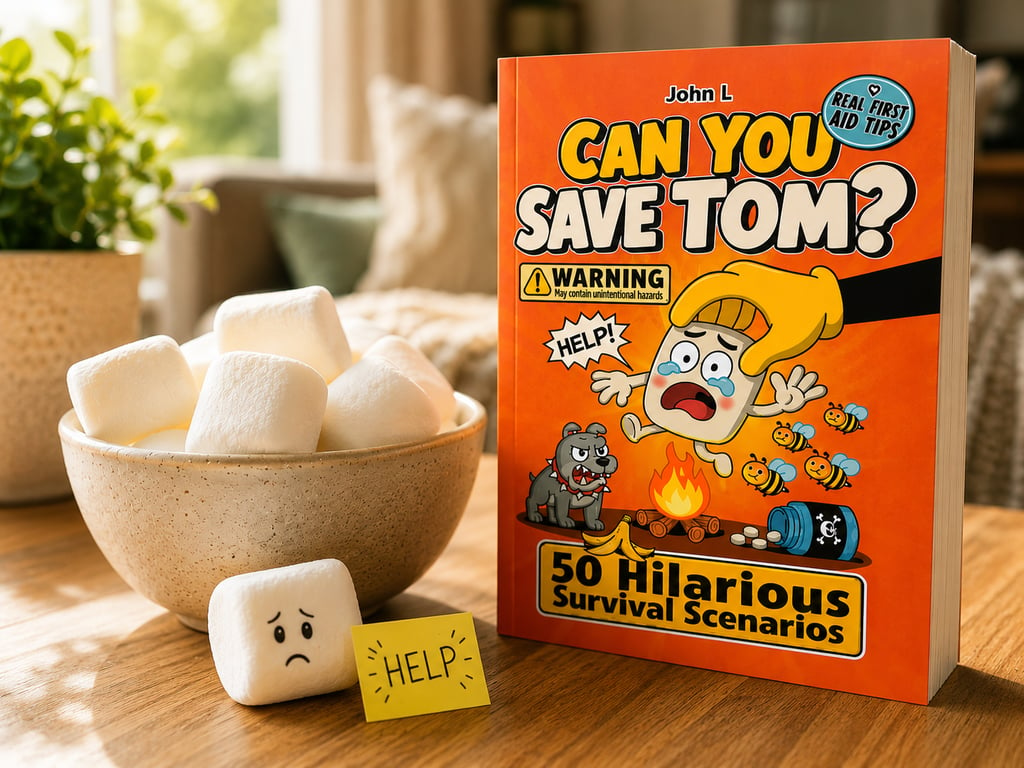
Every great story needs a hero. Most heroes are brave, resourceful, quick-thinking. TOM is none of those things — and that is exactly what makes him unforgettable. He is the hero you didn't know you needed, stumbling cheerfully from one catastrophic scenario to the next, completely convinced that everything will be fine.
You met TOM on Day 1. You got a taste of his fifty talent-for-disaster scenarios on Day 2. But today we go deeper. Today we ask the question that has puzzled readers, parents, and first-aid trainers alike: who, exactly, is TOM?
The answer, as TOM would tell you himself, is complicated. But mostly it involves gummy vitamins and a catastrophic misunderstanding of how treadmills work.
🍡 Words of wisdom from TOM
"I'm no survival expert. I'm barely human. But if there's a situation that could go wrong, I will find it — and I will fully commit to making it worse."
— TOM, Can You Save TOM? 50 Hilarious Survival Scenarios
What Makes TOM… TOM?
TOM isn't stupid. That's the thing. He's enthusiastic. He's optimistic. He approaches every situation with the unshakeable confidence of someone who has never once Googled "is this safe." He believes in himself completely, which would be admirable in almost any other context.
In Can You Save TOM?, this combination of cheerful confidence and spectacular misjudgement is precisely what puts him in fifty different life-threatening (or at least very uncomfortable) situations. And it's what makes each one so funny — because you can see exactly how TOM got there. His logic is impeccable. His outcomes are not.
💜 Why this works as a teaching tool
By showing TOM's flawed reasoning before revealing the correct answer, the book does something clever: it lets readers spot the mistake themselves. Children (and adults) who find TOM's logic funny are, almost without realising it, engaging in critical thinking. They are identifying exactly what went wrong — and that makes the correct answer stick far more effectively than any conventional safety lesson.
Why We Root for TOM Anyway
Here's the thing about TOM: despite all of the above, you want him to be okay. You want him to survive the gummy vitamin incident, avoid the snake, step off the treadmill at a sensible speed. Because TOM, for all his spectacular poor judgement, is fundamentally well-meaning. He is never reckless for the sake of it. He is just spectacularly, helplessly, lovably wrong.
And that — that warm, slightly frantic desire to keep TOM safe — is the engine that drives the whole book. It turns every safety lesson into a rescue mission. It makes first aid feel urgent rather than theoretical. You are not memorising a protocol. You are saving your friend.
The question the book poses on every page isn't "what is the correct first aid procedure?" — it's "can you save TOM?" And that personal stakes framing changes everything about how you engage with the information.
🍡 Straight from the marshmallow's mouth
"Look, I know what you're thinking. You're thinking, 'TOM, how do you keep finding yourself in these situations?' And honestly? That is a very good question. I've been thinking about it myself. The answer, as far as I can tell, is that the world is full of interesting things and I am full of interesting ideas, and occasionally these two facts collide in unexpected ways. That is not my fault. That is just physics."
Want to get latest updates on new books?
SubscRibe to our mailing list below
© 2025. All rights reserved.