
Tools + TOM = Trouble 🔧
Leave it in. Call 999. Never use a magnet. The safety tip companion to Chapter 25 — impalement first aid quick reference and the DIY rules TOM should have read first.
7/10/20264 min read
Yesterday TOM nailed his toe to the floor with a nail gun he was using to hang a single photo. Today is the practical companion — the one rule that covers every impalement scenario, the do/don't quick reference for when it happens, and the short list of DIY safety rules TOM will, going forward, claim to have known all along.
Impalement first aid is one of those topics where knowing one rule in advance is worth more than trying to work it out in the moment. So here it is, up front.
📖 From Chapter 25
"Tools + TOM = Trouble." — TOM's hard-won conclusion, delivered from the floor, still attached to it.
🔩
The One Rule for Impalement
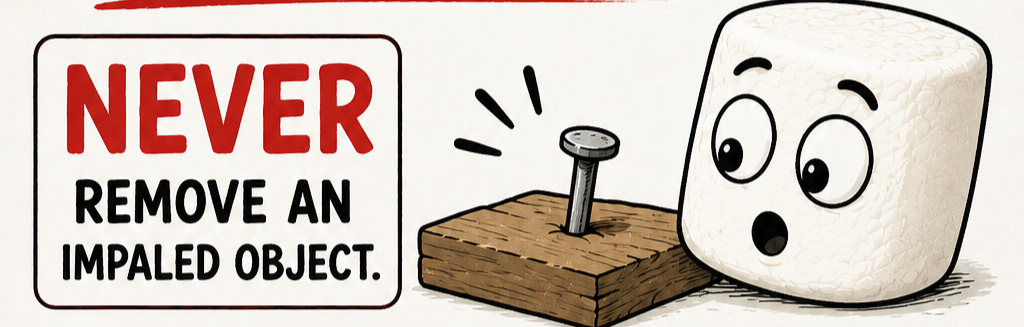
Never remove an impaled object. Leave it in place, call 999, keep the person calm and still, and support the area around the wound without touching the object. The hospital removes it — not you.
No exceptions. Ever.
That rule covers nails, splinters that have gone deep, glass, tools, or anything else that has penetrated tissue and stayed there. The reason is always the same: the object is plugging the wound and limiting blood loss. Removing it suddenly opens everything up. The removal happens in a controlled environment with the ability to manage what comes next — not on a hallway floor.
If it's already happened: what to do while waiting for 999
Call 999 — immediately, before anything elseAny penetrating injury from a power tool is a 999 call. Don't assess first, don't drive, don't wait. Call, then stay on the line for instructions while you move to the next steps.
Keep the person still and calmMovement risks moving the object, which risks additional tissue damage and increased bleeding. Sit or lie down — whichever is most stable without disturbing the affected area. Calm voices help. Panic does not.
Support the area around the wound — not the objectIf there is bleeding around the entry point, apply gentle pressure to the surrounding tissue using a clean cloth. Do not press on or near the object itself. Do not attempt to stabilise the object by packing around it unless the 999 operator instructs you to.
Watch for shock — and keep them warmSigns of shock: pale or grey skin, rapid shallow breathing, cold and clammy, confusion or drowsiness. Lay them down carefully (without moving the injured area), cover with a blanket, and keep talking to them until help arrives.
💡 The Rule That Saves
Leave it in. Call 999. Keep still. Support the surrounding tissue, not the object. These four instructions cover every impalement scenario from a nail to something far more serious — and they work because they're based on the same underlying principle every time.
Do vs. don't — quick reference
✓ Do
Leave the object exactly where it is
✗ Don't
Pull, yank, wiggle, or remove the object
✓ Do
Call 999 immediately
✗ Don't
Drive yourself to hospital with an impaled object
✓ Do
Apply gentle pressure to surrounding tissue if bleeding
✗ Don't
Press on the wound directly above the object
✓ Do
Keep the person warm and watch for shock
✗ Don't
Attempt to cut or shorten the object — any movement makes it worse
The DIY rules TOM should have read first
Chapter 25's secondary lesson is about the nail gun specifically — but the underlying principle applies to every power tool TOM has ever encountered with misplaced confidence.
🔫Nail guns
Never fire into a hard surface without a workpiece — the nail bounces back. Always wear safety glasses. Use sequential trigger models where possible, not contact-trip triggers.
Power saws
Always let the blade stop fully before setting it down. Never reach behind the blade. Keep fingers at least 15cm from the cutting line. Secure the workpiece.
🔨Hammers & mallets
Wear eye protection — nail fragments and wood chips are common. Start nails with light taps before driving. Don't use a hammer with a loose head.
Drills & screwdrivers
Check for cables and pipes before drilling into walls — always. Secure the workpiece so it can't spin. Keep drill bits sharp; dull bits require more pressure and are more likely to slip.
Ladders
Three points of contact at all times. Never overreach — move the ladder instead. Check the ground is stable and the feet are locked before climbing.
🥽PPE — the basics
Safety glasses for anything that generates chips, sparks, or dust. Hearing protection for sustained power tool use. Work gloves where grip matters. Steel toecaps if TOM is involved.
🇬🇧 UK Context
Call 999 for any penetrating injury from a power tool — these require emergency assessment and X-ray regardless of how minor they appear externally
Tetanus boosters are recommended after any puncture wound from a tool or nail — A&E will check your vaccination status and offer a booster if needed
HSE (Health and Safety Executive) guidance recommends sequential-trip nail guns over contact-trip models for reduced accidental discharge risk — worth knowing if buying or hiring
For minor DIY cuts (not impalements): clean under running water, apply pressure with a clean cloth, cover with a sterile dressing. If bleeding doesn't stop after 10 minutes of firm pressure, go to A&E or call NHS 111.
🚨 Serious Impalement — What 999 Will Tell You
For a significant impalement — anything beyond a surface-level nail or splinter — the 999 operator will guide you through exactly what to do while the ambulance is on its way. Stay on the line. Follow their instructions precisely. Do not attempt to remove or stabilise the object without their guidance. Keep the person as still as possible and keep talking to them.
Want to get latest updates on new books?
SubscRibe to our mailing list below
© 2025. All rights reserved.