
Who Approved the Fireworks 'Experiment'? 🎆
TOM has fireworks. TOM has questions. TOM has described what he is doing as an investigation rather than an experiment, which he feels is an important distinction. It is not.
6/3/20264 min read
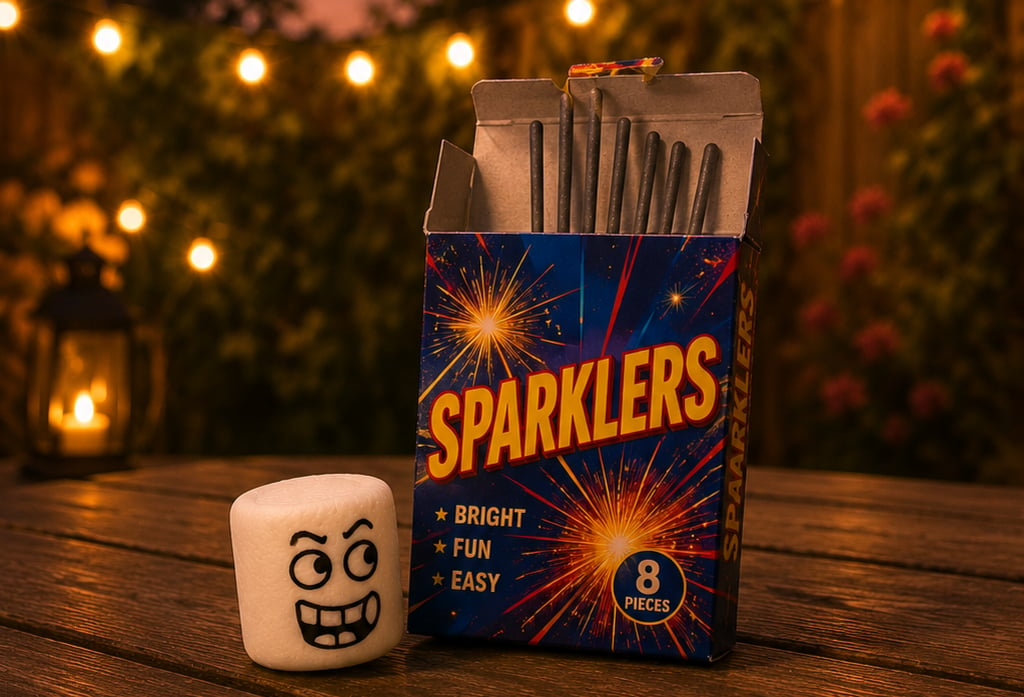
Vitamins. A snake named Gary. DIY dentistry. And now this. Chapter 4 of Can You Save TOM? escalates in a direction that will surprise nobody who has been paying attention. TOM has found a box of fireworks left over from Bonfire Night. TOM has several questions about how they work. TOM has decided that the best way to answer those questions is empirically.
No adult supervision was sought. No instructions were consulted. TOM described the activity in his notes — and yes, TOM keeps notes — as "an investigation." This is Chapter 4.
🎆 TOM's pre-investigation assessment
"I wouldn't call it an experiment. I'd call it an investigation. An experiment implies I don't know what will happen. An investigation implies I'm finding out. I am finding out."
— TOM, Can You Save TOM? 50 Hilarious Survival Scenarios, Chapter 4
The investigation does not go well. TOM finds out several things he did not intend to find out, including the effective blast radius of a rocket firework held at arm's length, and the precise moment at which "finding out" becomes "requiring assistance."
The Scenario
📖 Chapter 4 — The Situation
TOM is in the back garden. He has a box of leftover fireworks and a lit match. He has already launched one rocket and is describing the experience as "broadly successful, a few minor anomalies." He is now holding a second rocket and asking whether you think pointing it slightly downward at an angle would produce a different trajectory. He would also like to know what the fuse length on this one is. He is holding it at the time of asking.
What Do You Do? 🤔
A) Answer TOM's trajectory question. He seems to have a system. You don't want to interrupt the momentum.
B) Tell TOM to put it down carefully and step back a few metres — a short distance should be enough.
C) Take the firework from TOM yourself and put it back in the box so it can be dealt with safely later.
D) Tell TOM to put it down immediately on the ground pointing away from people, step well back — at least 15 metres — and not return to it under any circumstances. All remaining fireworks go back in the box, away from heat and ignition sources. ✓
Correct
💡 The Real Lesson
A lit or recently lit firework is never picked up, never held, and never returned to. Place it on the ground pointing away from people, retreat at least 15 metres, and wait. If it has already been lit and failed to fire, wait a minimum of five minutes before approaching, then soak it thoroughly with water. The distance isn't a suggestion — it's the minimum safe distance recommended by UK firework safety guidelines.
Why the Other Options Don't Work
❌ If you picked A — Answer the trajectory question
You have now become a participant in the investigation. TOM angles the rocket. The investigation produces new and unwelcome data. You are both within the blast radius. This is not what either of you intended, but it is what happened.
❌ If you picked B — Step back a few metres
"A few metres" is not far enough. UK safety guidelines specify a minimum of 15 metres for most consumer fireworks. The word "few" is doing too much work here. TOM steps back four metres and considers this adequate. It is not adequate.
❌If you picked C — Take the firework from TOM
Never take a lit or recently handled firework from another person. This transfers the risk to you and creates a moment of handover during which neither person has full control of the device. The ground is where it goes. Not a second pair of hands.
Why Fireworks Are a Different Category of Risk
The UK sees hundreds of firework-related injuries every year — and the majority of them don't happen at professional displays. They happen in back gardens, with consumer-grade fireworks, in exactly the kind of informal "investigation" TOM is conducting in Chapter 4.
The injuries are not trivial. Firework burns are among the most painful and serious of burn injuries because they combine high temperature, chemical burn, and often blast injury simultaneously. Eye injuries from fireworks are a leading cause of preventable vision loss. And the injuries disproportionately affect bystanders — people who weren't even the one holding the firework.
🎆 The UK legal position
It is illegal in the UK to set off fireworks in a public place, or between 11pm and 7am (midnight on Bonfire Night, 1am on New Year's Eve). Consumer fireworks are legal for private use in gardens, but the Fireworks Regulations 2004 place clear restrictions on their use. Handing a lit firework to another person, or using fireworks recklessly, carries a potential fine. TOM's "investigation" would fall comfortably within the definition of reckless.
📋 UK Firework Safety — The Rules TOM Did Not Consult
Never hold a lit firework in your hand — always use a proper firing position or tube.
Keep a minimum of 15 metres from fireworks once lit. More for larger devices.
Never return to a firework that has been lit, even if it didn't go off. Wait 5 minutes, then soak with water.
Store fireworks in a closed metal box away from heat sources. Never carry them in pockets.
Never throw fireworks — this is a criminal offence.
Keep a bucket of water nearby throughout. Have a phone available in case of emergency.
If someone is burned: cool the burn under running water for 20 minutes and call 999 for serious burns.
🚨 If a firework injury has already happened
For burns: cool the area immediately with running water for a minimum of 20 minutes. Do not use ice, butter, or any other substance. Remove jewellery and clothing near the burn unless stuck to the skin. Cover loosely with cling film or a clean non-fluffy material. Call 999 for serious burns, or 111 for guidance on minor ones. For eye injuries from fireworks: do not rub the eye, do not try to remove debris, cover loosely and get to A&E immediately.
TOM's Investigation: Final Report
You intervened before the second rocket was lit. TOM put it on the ground, pointing away from the fence, and stepped back to a distance you specified and he found "slightly excessive." The remaining fireworks went back in the box. The box went in the shed.
TOM's notes on the investigation conclude: "Findings: inconclusive. Further investigation required. Supervisor was overly cautious. Will revisit." He has not revisited. The box is still in the shed. This is the correct outcome.
Want to get latest updates on new books?
SubscRibe to our mailing list below
© 2025. All rights reserved.