
Wild Berries & Plants: If You’re Not Sure, Don’t
Yesterday TOM ate a mystery plant and learned the hard way. Today, the whole lesson distilled into one rule simple enough for a four-year-old to remember — and important enough that every young explorer should.
6/22/20263 min read
Children are natural foragers. A bright red berry at eye level on a hedge is, to a small person, basically a sweet that grew on a bush. Which is why this is one of the most useful single rules you can teach before any walk, park trip, or camping weekend — and the good news is, it’s short enough to stick.
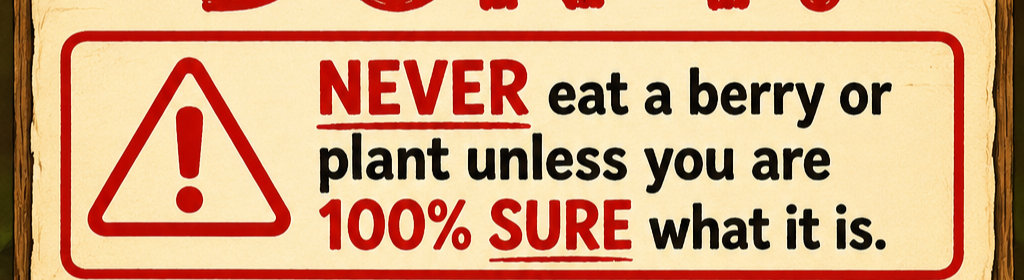
If you’re not sure, don’t.
Unless you are 100% certain what a berry or plant is, leave it alone. Don’t taste it, don’t nibble it, don’t “just try one.”on’t nibble it, don’t “just try one.”
That’s the entire rule, and its power is in being absolute. There’s no “probably fine,” no “it looks like the ones from the shop.” As we saw yesterday, the genuinely dangerous plants are the ones that look reassuringly familiar — poison hemlock passing for wild carrot, pretty foxglove that can affect the heart, berries and mushrooms that mimic edible ones. A child (or a TOM) can’t tell the difference, so the rule removes the guesswork entirely.
How to teach it so it sticks
The rule works best as a habit, not a one-off warning. A few ways to make it land with kids:
Make it a chant
“Not sure? Don’t!” Repeat it on walks until it’s automatic.
✋
Ask first, always
Teach them to point and ask a grown-up before touching any berry or plant — never pick and taste.
📷
Look, don’t taste
Berries are for spotting and admiring outdoors — only food from home or the shop goes in mouths.
The aim isn’t to make kids frightened of nature — it’s to give them one clear, calm boundary so they can explore freely. “Look at it, ask about it, but don’t eat it” lets curiosity run while keeping the one genuinely risky behaviour off the table.
📱 While you’re here: save the number
Is Poison Control saved in your phone? In the UK, NHS 111 handles poisoning advice, and 999 is for emergencies. Save them now, before a worried moment in a field with no signal to look things up — two minutes today, real calm later.
If a child does eat something
Even with the best rule in place, accidents happen. If a child eats an unknown plant or berry, the response is the same calm sequence from yesterday’s chapter: don’t panic, and don’t reach for “natural” fixes.
Remove any plant left in their mouth and rinse with water.
Don’t make them vomit or give milk, grass, or other “remedies.”
Keep a sample — a piece or a clear photo of the plant.
Get advice fast — NHS 111, or 999 if they’re unwell.
UK quick-reference — plant or berry eaten
Call NHS 111 for advice if they’ve eaten something unknown but seem well.
Call 999 for trouble breathing, swelling of the mouth or throat, severe vomiting, fits, drowsiness, or collapse.
Take a sample or photo of the plant to help identification.
Don’t induce vomiting or give “natural” foods to “balance” it.
In a real emergency
Some plant toxins act quickly. Swelling of the lips, mouth, or throat, difficulty breathing, fits, or collapse after eating a plant is an emergency.
Call 999 straight away and keep a sample of the plant if you safely can.
One rule, four words, endlessly portable: if you’re not sure, don’t. Print it, pin it, chant it on the way to the park. It’s the kind of small, simple boundary that lets kids roam and explore while quietly keeping them safe — and it’s a lot more fun to learn from TOM’s beard-tongue than the hard way. Tomorrow, TOM picks a fight with a vending machine. Spoiler: the machine has the high ground.
Want to get latest updates on new books?
SubscRibe to our mailing list below
© 2025. All rights reserved.